



Curriculum transformation is not four projects - it is a system of change
Dr Dhanushi Abeygunawardena and Diana Saragi Turnip
At UNSW, curriculum transformation is often described through four major components: Program Simplification, Assessment and Feedback, the Pedagogical Principles, and Flex-Semester Alignment (UNSW colleagues can find links to the respective SharePoint pages at the bottom of the article). At first glance, these can feel like separate streams of work, each with its own conversations, priorities and timelines.
While they may be separated for operational purposes, their educational value in addressing long-standing challenges in higher education depends on how well they are integrated in practice. This integration does not happen automatically. It has to be deliberately designed.
From separate initiatives to interwoven foundations
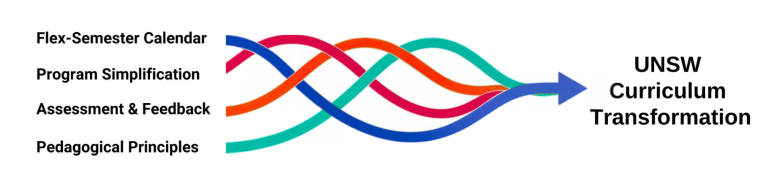
The four drivers of curriculum transformation operate more like interwoven threads.
- Flex-Semester Alignment reshapes pacing, sequencing and delivery
- Program Simplification streamlines program structure and student pathways
- Assessment and Feedback shapes how learning is experienced and demonstrated
- Pedagogical Principles guides what and how we teach
What we are redesigning is not the structure, assessment or delivery in isolation, but the whole learning experience. In practice, program teams are navigating all of these areas simultaneously.
This is where taking a program-level approach to curriculum and assessment design becomes critical. It is at this level that decisions about structure, assessment, pedagogy, and delivery can be made in relation to one another.
Why this is foundational work
With the pressure of deadlines, the Flex-Semester transition can easily feel like the primary driver and the endpoint of transformation. It is neither.
A systems perspective helps explain why. Systems thinking focuses on relationships and interactions rather than individual components (Cabrera & Cabrera, 2019). In higher education, outcomes emerge from how parts connect, not from the parts themselves (Dhukaram et al., 2018).
This shifts curriculum design away from improving individual courses to considering how learning develops across a program over time.
The UNSW Program-Level Assessment white paper (link for UNSW colleagues at the bottom of the article) reflects this shift. It frames assessment as part of an adaptive system requiring alignment across policy, curriculum, culture, and infrastructure. In this sense, Program-Level Assessment is not just a method but a way of working that makes learning progression visible, intentional, and coherent.
What we are seeing in practice: Our story from BABS
In the UNSW School of Biotechnology and Biomolecular Science (BABS), this shift to systems thinking and program-level approaches has been necessary.
Our teaching is consistently well received by students. However, because our courses contribute to broader generalist programs, curriculum decisions have traditionally been made at the course level. Despite strong local alignment efforts, persistent challenges remain.
For instance, our discipline evolves rapidly. While updates are often incorporated effectively within individual courses, the absence of a connected program-level design can lead to overlaps, gaps, and uneven progression.
A similar pattern emerges in assessment. We offer a diverse range of assessment tasks and feedback opportunities, yet where scaffolding is incomplete, significant efforts in marking and feedback do not always translate into meaningful gains in students’ long-term academic and professional development.
We have also observed shifts in how students approach and engage with learning, consistent with trends across higher education. This prompts us to reconsider the relevance of current teaching and assessment practices.
These are not isolated issues. They are systemic.
As Khanna et al. (2021) note, without an overarching systems perspective, curriculum design can become fragmented, even when individual components are well designed.
Recognising the opportunity presented by the UNSW-wide calendar transition, we have begun designing curriculum and assessment at the program level, even within the constraints of generalist programs. Using a backward design approach, we are defining progression across the programs before determining how it is enacted within individual courses.
Equally important has been the process. We have been encouraged by the genuine engagement of colleagues across both academic and professional roles in BABS. Through a modified Delphi approach combining surveys with world café-style workshops, we are working toward shared curriculum and assessment decisions before moving into delivery considerations.
These steps are building shared understanding and momentum while keeping sight of the whole program.
Working systematically through stages
A systems approach does not mean doing everything at once. It means progressing deliberately, with a clear view of the whole.
At UNSW, this is reflected in a staged Program-Level Assessment approach that:
- builds readiness through shared understanding
- supports design through mapping outcomes and assessment
- enables coordinated delivery across courses
- embeds monitoring and evaluation for ongoing refinement.
These stages are not strictly linear. In complex systems, change often produces unintended consequences (Stavrianeas et al., 2022). This is not inefficiency but rather how systems evolve.
The 2028 transition provides an important horizon, but it is not a finish line. The goal is not completion. What matters is building a sustainable systems approach that can adapt, improve, and remain coherent as it evolves.
Systems change is about people and practice
The most significant shift in this work is not structural. It is cultural.
Program-level approaches require changes to ways of working. They mean moving beyond individual courses to shape a shared specialisation/program. They require making connections visible, decisions explicit, and collaboration routine.
For us, this has meant more shared conversations about teaching, assessment, and student progression. It has meant surfacing and sharing decisions that were previously implicit.
This is where transformation actually happens.
Call to action
As you engage in this work, consider:
- What learning and teaching challenges are you trying to solve?
- Where are decisions still being made in isolation, and who else should be involved?
- Do your assessments reflect a coherent program-level learning journey?
- Do you need to revisit the curriculum to inform effective assessment strategies?
- How might the Flex-Semester transition be used to rethink, not just reorganise, teaching and learning?
Start by making the system visible. Work with others.
Curriculum transformation is not about doing more.
It is about working more coherently, together.