


From silence to signal: making student thinking visible
By Dr Fida Hasan
When student engagement thins out, the question isn’t how to make students talk. It’s how to make their thinking visible.
It’s a Monday evening, just past six. The lecture has started, cameras are off, and there are about forty names in the participant pane. I ask a question and wait. The pause stretches. Eventually someone unmutes, usually the same student who unmuted last week, and we settle into a pattern every online teacher knows: a few willing voices, a much larger silent majority, and me at the front, unable to tell whether the silence means “I understand”, “I’m lost”, or “I’m just trying to get through the day”.
If you teach, you know this room. It exists in person classroom too.
My postgraduate cybersecurity students at UNSW are mostly working professionals who log in for evening classes after a full day at work, in groups of forty-plus from a class of over a hundred. They arrive tired. They rarely know one another. Cameras stay off, so engagement is invisible by default.
My in-person undergraduates are a different crowd, but the result looks much the same. The room is full of curious learners, yet curiosity and confidence are not the same thing. Peer pressure quietly silences minority views. And the conceptual topics in cybersecurity, the ones that benefit most from collaborative sense-making, are exactly the topics most likely to die in the gap between what students think and what they are willing to say out loud.
The silence isn’t apathy. It’s architecture.
It’s tempting to read student silence as a motivation problem. To me, it’s predominantly a design problem. We have built rooms, physical and virtual, that reward the loudest voice and penalise the cautious one. And, in general, we have equated “engagement” with “speaking up” and then wondered why so many students opt out.
The good news is that we already have tools that can change this. The harder truth is that most of us either don’t use them or use them decoratively: a single icebreaker poll in week one, never to be seen again. I’ve done this myself. What I’ve noticed is that the real difference lies in the gap between having a tool and building it into how we teach.
From talking to thinking: a simple shift
For the past several semesters, I have been working with one such tool, Mentimeter (also known as Menti). It belongs to a small family of live-polling tools, sometimes called audience or student response systems, which also includes Slido, Kahoot, and, more simply, a well-designed Google Form. What draws me to Mentimeter specifically is how it disappears into the lecture: students respond anonymously from any device, at the same moment, with no login or account required. Word cloud, multiple choice, open text, scales: same room, every voice, all at once.
The tool itself is not the point. The real shift is deliberately designing moments where students’ invisible thinking becomes visible.
Four touchpoints, applied consistently
I treat polling not as a feature but as scaffolding: four small moments in every lecture, each with a clear pedagogical job. I open with a pulse, a sixty-second word cloud or scale that shows what students already think they know. Mid-lecture comes a concept check; if the results are split, I re-teach, and if they’re solid, I move on. A debate prompt surfaces the full range of views in a way open Q&A rarely does. I close with an exit ticket: sixty seconds of anonymous “muddy points” that become the opening of next week’s class.
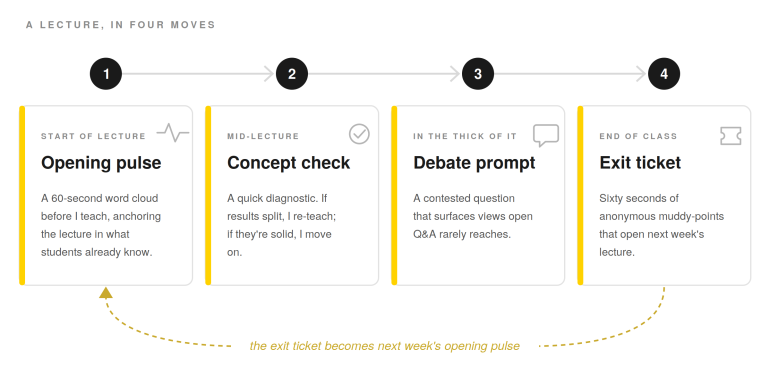
Used consistently, these polls become part of how the room works rather than occasional gimmicks.
Why it works: the pedagogy underneath
None of this works because polling is novel. Polling works because it rests on established pedagogical foundations. As Hattie’s synthesis of meta-analyses showed, formative assessment as a high-impact influence on student learning. Anonymous responses can also lower what Krashen called the “affective filter”. Asking students to actually do something with a concept engages the higher levels of Bloom’s taxonomy.
In other words, the value, therefore, lies not in polling itself, but in the question design, timing, and how teachers use the results.
What doesn’t work
There are clear failure modes, and I have met most of them. Polling for polling’s sake, running an activity because something ran the previous week, or ignoring the results undermines trust. Using polls for graded assessment removes the anonymity that makes responses honest. A poll cannot rescue a weak lecture, and too many polls can turn a two-hour session into a survey.
Each activity costs two to three minutes of class time, good questions take real effort to write and free polling tiers may not accommodate a cohort of more than 100 students. The approach requires careful choices about which concepts deserve a moment of made-visible thinking.

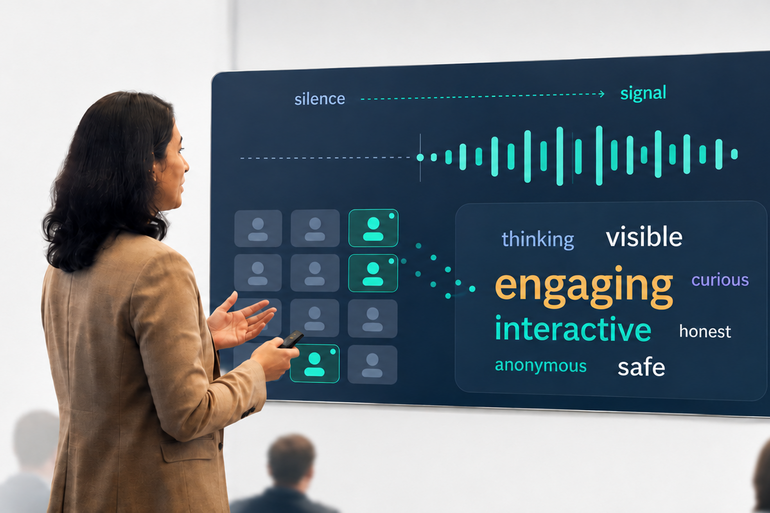
I recently rendered comments from our MyExperience student survey as a word cloud. The two largest words were not cybersecurity, or content, or lectures. They were engaging and interactive.
Some of my students nominated me for a Student’s Choice Teaching Award in 2025. One described precisely why the approach worked:
“He goes above and beyond to make complex cybersecurity concepts clear, especially when I was struggling to understand some foundational ideas. His use of Mentimeter during lectures turns the whole class into an interactive experience.” - Anonymous student nomination comment
I include this not as praise but as evidence, because of what the student connected: interactivity and feeling supported while struggling. The polling made the room feel safe enough to admit I don’t understand this yet, and that safety helped the harder concepts land.
The takeaway
If there is one shift I would offer colleagues thinking about classroom engagement, it is this: stop asking “how do I make students talk?” and start asking “how do I make student thinking visible?” The first question puts the burden on the student. The second puts it where it belongs, on the design of the room.
Tools matter, but only as much as the pedagogy they sit inside. The silence in our classrooms is rarely the absence of thought. It is the absence of an invitation that feels safe enough to take.