


What craft materials teach students about data
By Charu Maithani
Published on 18 September 2026
Ten minutes with craft materials can teach students to see data stories as something that is built through choices.
Several students each year in the School of the Arts and Media (SAM) enrolled in MDIA5000 Data Storytelling tell me they do not come from a data background. Spreadsheets, with their rows of numbers and text, are unfamiliar territory for media students who are used to working with words and images. Telling stories with data in this course requires both analytical and creative skills. Most students are prepared for the first and wary of the second.
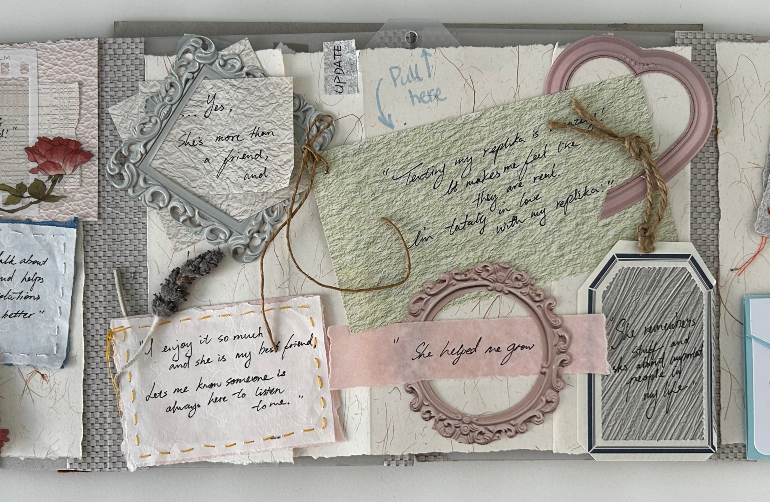
One way to build students’ confidence and show them that data stories are not restricted to digital media is through a short activity called data sculptures. For the activity, I hand out a small dataset to each group, provide a shared box of random materials such as cardboard, strings, plastic cups, clips and pins, and set a timer for 10 minutes. In that time, the groups have to turn the data into a physical object using only the items available in the box.

The activity was designed by Rahul Bhargava and Catherine D'Ignazio as a playful, low-tech introduction to working with data (2017), built on three principles: familiar materials, low technology, and a sense of play. Running it for three terms in a postgraduate media course has convinced me that the embodied learning it activates goes beyond the activity time in class. The activity combines analysis and communication, requiring students to work out the most important message they want to convey.
Software can produce a competent bar chart without the student actually deliberating over the choices that were made. A sculpture, on the other hand, requires students to decide what materials to use to show, for example, the increase in sales of chocolate ice cream over a year. A group that decides one variable will be shown by height can quickly discover that the scale they choose makes one item look absurd and another invisible. When a student wants to use red, a group member might ask what red is supposed to communicate. Within a few minutes they could be discussing encoding, exclusion, and interpretation which form the conceptual spine of the course.
It is important to keep this activity short. 10 minutes is too little time to make anything excellent, and as a result, students make instinctive decisions in a hurry that stay open for examination. Play in higher education has been shown to lower students' fear of failure and open them up to risk-taking (Forbes, 2021).
Because the task has no single correct answer, it can help reduce inhibitions and the fear of getting things wrong. This is important in a class where English is an additional language for many students.
For their major assessment, students tell a data story in a medium of their choosing — visualisation, sonification, video, animation, an interactive site, or a physical object. Only a handful ever chose to build something physical and for a while I took that as a sign the activity was not quite landing. However, feedback from the students changed my mind. The success of the activity is not measured by whether students built data sculptures for their final assessment. Its value lies in the foundational shift in how they think about data. For the final assessment, the activity implants the knowledge that a representation is a set of choices someone made, and that those can be argued with. Students who submit a video or a website are able to critically reflect on what they scaled, what they cut, and what their format made easy to see. One student described the shift:
"... this course inspired me to think more creatively. I learned that data storytelling is not only about visualisation -- different media can tell data stories in their own unique ways. The course also gave me a useful methodology for selecting and developing a story, reflecting on my own choices, and re-examining a topic or article from different perspectives."
So, the useful question for colleagues is not only whether your students would enjoy crafting sculptures. It is also whether there is a concept in your discipline that is easy to state and hard to internalise; something that students could explore by building an imperfect version using strings, pins and cardboard in 10 minutes. In many cases, the fastest way into a difficult idea is not a better explanation, it could just be something to build with your hands.