


Published on 5 February 2026
Teaching in the age of AI: why immersive learning matters
As generative AI reshapes assessment, immersive learning can offer a path to authentic engagement that can't be outsourced.
The conversation about generative AI in higher education has become impossible to ignore. In staff rooms, conferences, and online forums, academics are grappling with a fundamental question: how do we teach meaningfully when students have unprecedented access to tools that can write essays, summarise readings, and generate reports at the click of a button?
This isn't about technophobia or resistance to change. It's about something more fundamental: ensuring students are actually learning and not just submitting work by the due date. For those of us teaching text-heavy subjects, like cybersecurity governance and policy, this challenge feels particularly acute.
The vulnerability of text-based assessment
Cybersecurity policy and governance courses have traditionally relied on case studies, written analyses, and reflective reports. Students read scenarios, apply frameworks, and articulate their reasoning in essays and position papers. It's a model that has served us well for decades.
But GenAI has shifted the ground beneath our feet.
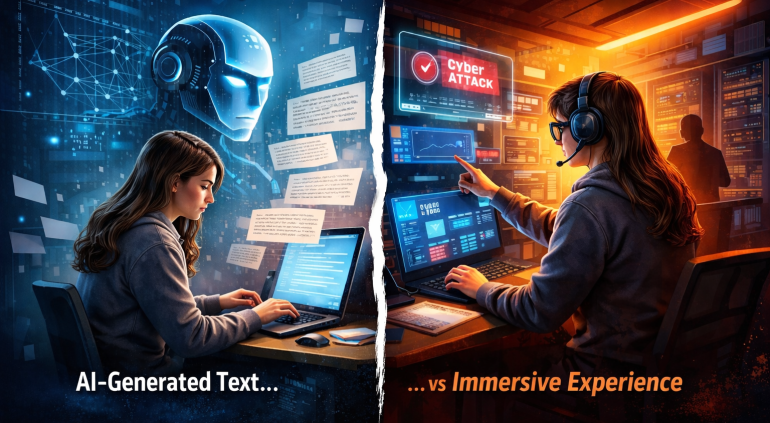
When assessment primarily involves producing text, the temptation for students to lean too heavily on AI tools becomes significant. And while AI can generate plausible-sounding prose, it can't replicate the deep cognitive engagement that comes from wrestling with a complex scenario, making difficult trade-offs, or experiencing the consequences of a decision. It can also lead to what is now termed AI Slop: text that is coherent, but shallow.
The risk isn't that students are "cheating"; many are simply trying to manage overwhelming workloads efficiently. The real risk is that they're bypassing the very experiences that build genuine understanding and trading this off for what can be thought of as easier.
This realisation led us to ask: what if we designed learning experiences that AI simply couldn't do on a student's behalf?
Building learning that can't be outsourced
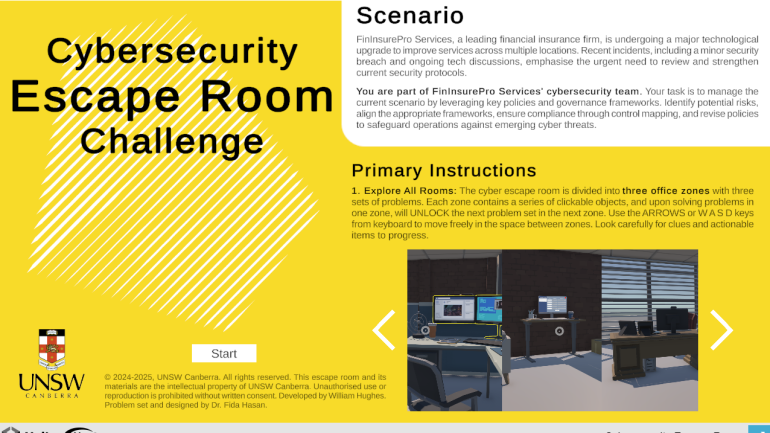
At UNSW Canberra, with support from the UNSW Canberra Education Innovation Fund and the Course Design Institute Fund at UNSW Sydney, my colleagues and I have developed a gamified, immersive 3D learning environment for teaching cybersecurity governance. Rather than asking students to write about hypothetical scenarios, we place them inside those scenarios.
Students navigate realistic organisational environments, explore virtual offices and server rooms, interview simulated stakeholders, analyse competing priorities, and make consequential decisions about cyber risk and policy implementation. Their learning artefacts emerge from direct engagement with these experiences, not from abstract readings or AI-generated summaries.
The pedagogical principle is straightforward: AI can write an essay about risk management, but it can't meaningfully explore a 3D environment, experience the narrative tensions of competing stakeholder demands, or make embodied decisions within a complex scenario. The assessment becomes inseparable from the doing.
AI as support, not a substitute
None of this is about banning AI or pretending it doesn't exist. Students will, and should, use AI tools in their professional lives. The goal isn't to create AI-free zones, but to design learning experiences where AI serves as a support rather than a substitute.
Students might still use AI to help structure their reflections or explore additional perspectives, to improve their experience. But the substance of their learning – the exploration, the decision-making, and the sense-making – happens in an environment where AI can't do the work for them.
We presented our work at the International Society for the Scholarship of Teaching and Learning (ISSOTL) Conference 2025 and it was published in Education Sciences 2026, a Q1 journal focused on educational innovation. That validation from the scholarly community confirms that others see value in this direction.
Rethinking what's possible
As generative AI continues to evolve, the pressure on text-based assessment will only intensify. We can respond by building better AI detectors, designing elaborate plagiarism policies, or lamenting a perceived decline in student integrity. Or we can step back and ask a more productive question: what kinds of learning experiences are inherently meaningful, engaging, and resistant to outsourcing, not because they're technologically locked down, but because they're pedagogically sound?
Immersive, experiential learning offers a compelling path forward and reminds us that education at its best has always been about doing, exploring, failing, and making sense of complex problems, not just producing text.
As educators, we have an opportunity to design learning that students want to engage with, not circumvent. The age of AI doesn't have to be the age of disengagement. If we're willing to rethink what learning looks like, it might just be the opposite.